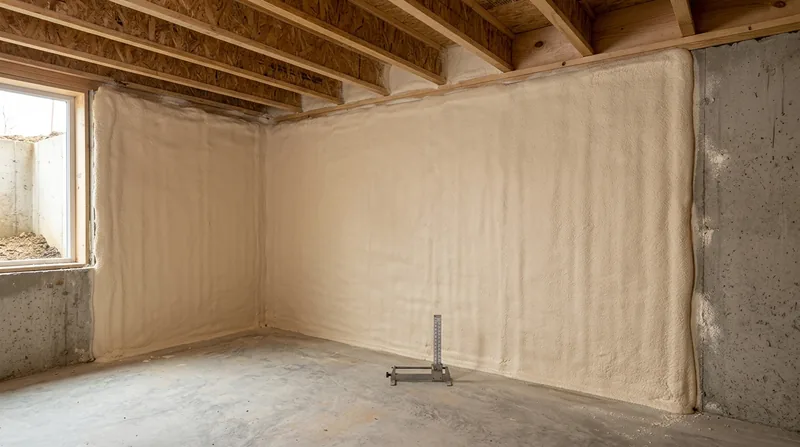




Closed cell spray foam insulation in Youngstown is the heavy-duty answer for the Mahoning Valley's extreme seasonal swings. Winter ice dams, humid summer vapor drive, January rim joists that frost over, basement walls that sweat in spring, pole barns that collect condensation on steel: closed cell delivers R-6.5 per inch with its own vapor retarder and real structural stiffening. In a region where older homes sit on stone block foundations, where balloon-framed worker homes run thin walls over empty cavities, and where newer colonials perch bonus rooms above attached garages, two-pound closed cell handles the moisture and the temperature stress that fiberglass and open cell cannot. We have been doing this work in Youngstown since 2012. This page explains what closed cell is, why it works here, what it costs, and how to find a contractor you can trust.
Why Closed Cell Spray Foam Matters in Youngstown's Climate and Building Stock
Youngstown winters are long and snowy. Summer humidity flips the vapor drive so moisture wants to travel inward. Every assembly in this region has to handle both seasons without rotting, sweating, or icing. Closed cell foam is the only insulation product that carries its own vapor retarder built into the foam itself, which means you do not install a separate plastic barrier and risk trapping moisture on the wrong side of the wall or rim joist. The foam cures to a rigid, water-resistant shell that does not absorb moisture and does not settle or sag like fiberglass batts.
- A stone or concrete block basement wall sprayed with closed cell stays dry because the foam seals the wall and the vapor retarder stops moisture from wicking through the block.
- A rim joist or band joist in a 1940s cape or ranch, where the original fiberglass is flattened and the space is open to the attic, gets sealed and insulated in one pass with no thermal bridging through the rim board itself.
- A pole barn or machine shed with a steel frame collects condensation on the inside of the metal skin when the outdoor temperature drops below the dew point inside the building, and closed cell foam stops that sweat because the foam is vapor-impermeable and the assembly stays above dew point.
- An attic above a finished bonus room over an attached garage does not frost inside the rim cavity in January because the closed cell creates a thermal break and a vapor seal that stops cold from radiating inward.
This is why closed cell is the standard answer for any Youngstown assembly that faces a hard winter and summer humidity in the same year.
Key info: Closed cell foam is also the only spray insulation that adds structural stiffening to the rim joist and roof deck. In a Youngstown attic or crawl space, that extra rigidity means the assembly resists racking and wind load, and the foam itself becomes part of the structural envelope. That matters in a region with heavy snow loads and January ice dams.
For more detail on how closed cell compares to other insulation methods in Youngstown, see our guide to open cell spray foam insulation, which is the lighter-duty and more budget-friendly attic option when moisture control and structural strength are not the primary drivers.
How We Install Closed Cell Spray Foam in Youngstown Attics, Crawl Spaces, and Rim Joists
Closed cell spray foam is applied as a liquid from a heated spray rig, mixed at the gun, and expands to fill cavities and seal air leaks. The process is fast, but it requires precision. The installer must control the thickness per pass (usually 1 to 1.5 inches), maintain the correct drum temperature and chemical ratio, and ensure the space is mechanically ventilated during cure so volatile organic compounds (VOCs) can escape. Once cured, the foam is inert, low-VOC, and ready for drywall or attic flooring.
- We inspect the substrate (attic floor, rim joist, crawl space wall, or roof deck) and identify any moisture, active leaks, or contamination that must be fixed before foam is applied.
- We set up mechanical ventilation (a fan pulling air out of the space during and after the spray) to manage cure fumes and ensure safe re-entry within 24 to 48 hours.
- We spray closed cell in controlled passes, building thickness gradually so the foam cures evenly and reaches its full R-value without thermal shock or uneven density.
- We seal all rim joists, band joists, rim board edges, and any air leaks around rim cavities, electrical penetrations, and plumbing chases so the entire envelope is air-tight.
- We remove or dispose of old fiberglass, mineral wool, or failed foam before spraying, because foam cannot adhere to a dusty, wet, or contaminated surface.
The job is complete when the foam has cured, the space is re-entry safe, and the assembly is ready for drywall, flooring, or mechanical work to proceed.
Example: A 1920s Colonial in Crandall Park with a full third-floor attic and a rim joist that runs 60 linear feet around the perimeter. The rim was never insulated, and the attic above it stays 15 degrees colder than the second floor in January. We remove the old fiberglass from the rim cavity, spray 2 inches of closed cell around the entire rim, seal the rim board edges and the band joist where it meets the rim, and the third floor stays 8 to 10 degrees warmer with no drafts and no ice dams at the eave line.
For a detailed look at how we handle attic and crawl space work, visit attic spray foam insulation in Youngstown or crawl space spray foam insulation in Youngstown.
| Application | Description | Best For |
|---|---|---|
| Rim and Band Joist | 2 to 3 inches of closed cell sprayed into the rim cavity, sealing the rim board edges and the band joist where it meets the foundation. | Any basement or crawl space in Youngstown, especially older homes with uninsulated rims and drafty first-floor rooms. |
| Attic Roof Deck (Sealed/Unvented) | 4 to 6 inches of closed cell sprayed directly on the roof deck (rafters, sheathing, and all) to create a sealed, unvented attic with no soffit vents or ridge vents. | New construction, re-roofing projects, or homes with attic condensation and ice dam problems. |
| Basement Wall and Foundation | 2 to 4 inches of closed cell sprayed directly on stone block or poured concrete foundation walls to seal and insulate in one pass. | Finished basements, bonus rooms, and crawl spaces in Youngstown where moisture control and thermal break are essential. |
| Pole Barn and Metal Building | 3 to 4 inches of closed cell sprayed on the underside of metal roof and wall panels to prevent condensation on the inside of the steel skin. | Agricultural buildings, machine sheds, and commercial warehouses in rural Youngstown, Mesopotamia, and Farmington where steel condensation is a chronic problem. |
| Garage Ceiling | 2 to 3 inches of closed cell sprayed on the underside of the garage roof deck or ceiling joists to insulate the garage and reduce heat loss to the rooms above. | Attached garages in Youngstown where bonus rooms or finished space sits directly above and stays cold in winter. |
Each application is measured on site and specified with R-value and thickness in writing before any work begins.
Closed Cell Spray Foam Insulation Cost in Youngstown: What to Expect
Closed cell spray foam costs more per board foot than open cell or blown-in fiberglass, but the price reflects the density, the R-value, the vapor retarder, and the structural stiffening that come with the product. In Youngstown, closed cell starts at around $1.20 per board foot for straightforward applications like rim joists and crawl space walls. A typical rim joist job covering 60 linear feet of a basement or crawl space runs 120 to 180 board feet and costs between $1,500 and $2,200 before any removal or site prep. An attic sealed with closed cell on the roof deck costs more because the area is larger and the thickness is greater, but the job is a one-time fix for ice dams, condensation, and heating loss.
The actual cost depends on several concrete factors. Access matters: a rim joist at ground level is faster to spray than one buried behind stored items or obstructed by plumbing. The substrate condition matters: if old fiberglass or mineral wool must be removed first, that adds labor and disposal cost. The thickness you choose matters: 2 inches of closed cell delivers R-13, while 4 inches delivers R-26, and the difference is $0.30 to $0.40 per board foot. The size of the job matters: a small crawl space or rim joist is a quick hit, while a sealed attic or a full basement wall is a larger ticket and benefits from economy of scale.
The best way to understand your cost is to call us at (330) 406-5409 and request a free, no-obligation estimate. We measure the space on site, identify any prep work, and give you a written estimate with R-value and thickness specified. We do not charge for the estimate, and there is no obligation to book. Visit our pricing page for more detail on how we structure our fees.
What to Look for When Hiring a Closed Cell Spray Foam Contractor Near Me in Youngstown
The spray foam insulation market in Youngstown includes local shops, national franchises, and out-of-state crews who spray a job in an afternoon and leave when problems appear. The difference between them is not always obvious from a website or a phone call. The honest contractor is the one who gives you a written estimate with R-value and thickness, who explains the cure process and the re-entry window, who provides proof of insurance, and who can be reached after the job is done. The warning signs are an estimate with no R-value and no thickness, a price far below market with no inspection, a promise of immediate re-entry, insurance that cannot be verified, and a contractor who is hard to reach once the smell lingers.
Before you hire any spray foam contractor, including us, ask these questions:
- Request a written estimate that specifies the R-value per inch, the thickness in inches, and the total board feet to be sprayed.
- Ask whether the contractor is fully insured and ask to see a certificate of insurance that names your property as the additional insured.
- Ask about the cure process: how long the mechanical ventilation runs, when the space is safe for re-entry, and what the smell timeline looks like.
- Ask for references from recent jobs in Youngstown, Boardman, Austintown, or nearby, and call at least two to ask about the quality of the work and whether the contractor was reachable after the job.
- Ask about permits: the contractor should know what applies at your address in Youngstown or your specific city, and should help you navigate the local building department if a permit is required.
- Verify that the contractor is not making promises about energy savings, lifetime warranties, or mold remediation, because those are red flags for overstatement and unrealistic claims.
If you are ready to get started, contact us for a free estimate or call (330) 406-5409. We will measure your space, explain what applies at your address, and give you a clear, written price with no surprises.
Closed Cell Spray Foam Insulation in Youngstown: Pricing Guide
| Service | Price | Details |
|---|---|---|
| Rim and Band Joist Insulation | Starting at $1.20/board ft | Two to three inches of closed cell sprayed into rim cavities, sealing the rim board edges and band joists in basements and crawl spaces |
| Crawl Space Wall Insulation | Starting at $1.20/board ft | Two to four inches of closed cell applied to foundation walls, sealed and vapor-retarded in one pass, no separate plastic barrier needed |
| Sealed Attic Roof Deck | Starting at $1.30/board ft | Four to six inches of closed cell on roof deck to create unvented attic, stops ice dams and condensation, larger area and greater thickness than rim work |
| Metal Building or Pole Barn | Starting at $1.25/board ft | Three to four inches of closed cell on steel roof and wall panels to prevent condensation sweat on the inside of the metal skin |
| Insulation Removal and Replacement | On estimate | Old fiberglass, mineral wool, or failed foam must be removed before spray, labor and disposal cost depend on volume and site access |
| Free Estimate | No charge | On-site measurement, R-value and thickness specified in writing, no obligation to book, response within 24 hours at (330) 406-5409 |
Indicative pricing, the exact cost depends on square footage, finish, and site access. Free personalized estimate within 24h at (330) 406-5409.


