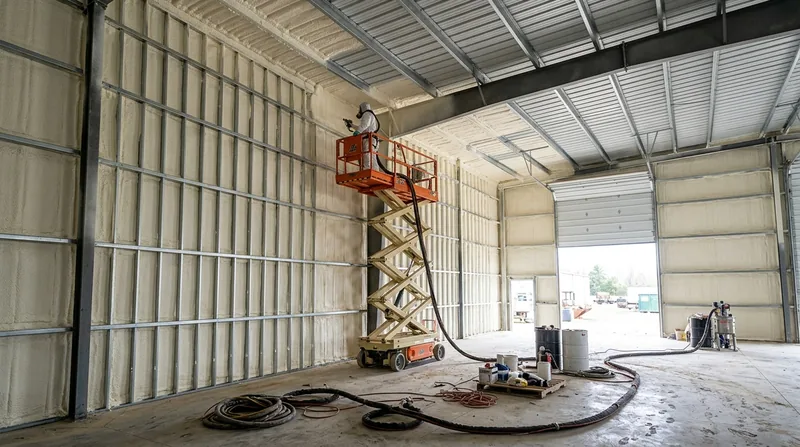




Commercial & New Construction Spray Foam in Youngstown keeps warehouses, offices, churches and production facilities code-compliant and thermally tight from day one. The Mahoning Valley's industrial corridor, from the Lordstown battery plant south through North Jackson's distribution hubs and into the steel-era warehouse blocks along the river, runs year-round construction and retrofit schedules that demand insulation crews who show up on time, pull the right permits, and leave documentation your building department will actually accept. Phased work keeps your operation running while we spray. Winter snow loads, summer humidity swings, and the long heating season that defines northeast Ohio mean every assembly has to handle both seasons without fail. We remove failed insulation, spray code-compliant closed cell or open cell foam with the right R-value and thickness for your assembly, and seal every air leak so your envelope performs.
Why Commercial & New Construction Spray Foam Matters in Youngstown's Industrial and Institutional Landscape
Commercial buildings in Youngstown face two competing pressures: thermal performance that holds up through four months of heavy snow and ice, and energy efficiency that shows up in operating budgets. Warehouses built in the 1980s and 1990s with fiberglass batts or blown-in cellulose see condensation on metal roof decks in spring; new construction with air leaks at band joists and rim cavities burns heating fuel all winter and then cools inefficiently in summer. Spray foam seals the building envelope at every thermal break, and closed cell foam on metal decks stops the condensation that rusts fasteners and rots OSB before the building is ten years old. Your building department requires documentation of R-value and thickness; we provide it with every job. Phased work and mechanical ventilation during cure mean your crew can move back in on schedule.
- We spray closed cell foam on metal roof decks to control condensation and deliver R-value above R-20 in a single 2.5-inch pass.
- Open cell foam in attics and wall cavities of new construction costs less and still achieves code R-value with thicker application.
- We air seal rim joists, band joists, and perimeter walls so your HVAC system does not work against air leaks.
- Mechanical ventilation during cure and a stated re-entry window keep your schedule intact and your crew safe.
- We help you navigate what permits apply at your address and deliver code-compliant documentation your building department will accept.
Every commercial job in Youngstown is built to stay tight through the heating season and handle the humidity swings that define the valley.
Local example: A 40,000-square-foot warehouse in Struthers with a metal roof deck and 1990s fiberglass insulation saw rust bloom on the fasteners and soft spots in the OSB every spring. We removed the failed insulation, sprayed 2.5 inches of closed cell foam at R-20 minimum, sealed the rim joist, and installed mechanical ventilation during cure. The condensation stopped. The building department approved it with our thickness and R-value documentation. The owner's heating bill dropped 18 percent in the first winter.
For more detail on how closed cell foam controls condensation on steel, see our closed cell spray foam insulation page.
How We Execute Commercial & New Construction Spray Foam in Youngstown: Phased, Documented, On Schedule
Commercial work in Youngstown runs on a builder's schedule or a facility manager's operating window. We show up on time with the crew, equipment and permits in order, spray the foam with controlled thickness per pass and the manufacturer ratio verified, and leave mechanical ventilation running until re-entry is safe. Documentation is built into every job: R-value, thickness, application date, re-entry window, and your building department's requirements met before we leave. Phased work means we can spray one section while another remains occupied. We remove failed insulation first if the substrate is sound, or we walk away if moisture, contamination or active leaks make foam the wrong call.
- We meet with your general contractor or facility manager to review the scope, timeline, and any occupied zones.
- We confirm the insulation specs with your general contractor before we spray.
- We inspect the substrate for moisture, active leaks, or contamination; if found, we address it first or recommend a different approach.
- We spray foam with controlled thickness per pass, verify the drum temperature and manufacturer ratio, and document each pass.
- We run mechanical ventilation during cure and post a re-entry window of 24 to 48 hours depending on foam type and ambient conditions.
- We provide R-value, thickness, and application documentation that your building department will accept without question.
The result is a thermal envelope that holds up through winter, a building that stays dry in spring, and paperwork your inspector can sign off on immediately.
Phased work example: A new office building in Canfield had three zones: the main floor occupied by a tenant move-in crew, the second floor under construction, and the basement mechanical room in use. We sprayed the second floor and basement on day one with mechanical ventilation running, sealed the main-floor rim joist and band joist in the evening after the tenant crew left, and re-entered all zones within 48 hours. The building department inspected on day three and approved it with our documentation in hand.
See our air sealing page for detail on how sealing rim and band joists reduces heating load in commercial buildings.
Commercial & New Construction Spray Foam Methods: Closed Cell, Open Cell, and Retrofit Injection
| Approach | Description | Best for |
|---|---|---|
| Closed Cell Spray Foam | High-density foam, R-6 to R-7 per inch, vapor-impermeable, applied 2 to 3 inches per pass. Requires controlled drum temperature and manufacturer ratio. Mechanical ventilation during cure. | Metal roof decks, condensation-prone assemblies, rim and band joists, retrofit injection into existing wall cavities, any assembly where vapor control is non-negotiable. |
| Open Cell Spray Foam | Lower-density foam, R-3.5 to R-4 per inch, vapor-permeable, applied in thicker passes. Lower material cost, same crew and equipment. Mechanical ventilation during cure. | Attics in new construction, interior walls where vapor permeability is acceptable, sound dampening in office spaces, budget-conscious retrofit of non-metal assemblies. |
| Injection Foam Retrofit | Closed cell foam injected into existing wall cavities through small holes, no demolition, minimal disruption. Requires careful assessment of cavity depth and obstructions. Sealed holes afterward. | Pre-1980 warehouse walls, steel-frame buildings with empty cavities, retrofit of occupied commercial buildings where demolition is not an option. |
| Removal and Replacement | We remove failed insulation, verify the substrate, and spray new foam. Asbestos and vermiculite are flagged and referred to licensed professionals; we do not disturb them. | Warehouses with deteriorated fiberglass or cellulose, any assembly where the existing insulation is wet, contaminated, or thermally failed. |
Commercial & New Construction Spray Foam Cost in Youngstown: What to Expect
Pricing for commercial spray foam depends on foam type, R-value required by code, building size, substrate condition, and whether removal is needed. A free commercial estimate is the starting point; we meet on site, measure the square footage and height, identify the foam type and thickness needed for your assembly, and provide a realistic number. Closed cell foam costs more per board foot but delivers higher R-value in thinner passes, making it the right choice for metal decks and retrofit injection. Open cell foam costs less but requires thicker application to reach the same R-value. Removal of failed insulation adds labor and disposal cost. Access, weather conditions during application, and whether work is phased around occupied zones all factor into the final price.
- Closed cell foam on a 10,000-square-foot metal roof deck at R-20 typically ranges from $8,000 to $14,000 depending on current height and access.
- Open cell foam in a new-construction attic at R-38 typically ranges from $6,000 to $10,000 for the same square footage.
- Injection foam retrofit of a 1980s warehouse wall typically runs $3,000 to $7,000 for a 5,000-square-foot section depending on cavity depth and obstruction.
- Removal of failed insulation adds $1,500 to $4,000 depending on square footage and disposal requirements.
Every commercial job is different. Call us at (330) 406-5409 for a free estimate; we respond within 24 hours. See our pricing page for more detail on what moves the cost up or down.
What to Look for When Hiring a Spray Foam Contractor Near Youngstown
Commercial spray foam work is not a race. A contractor who shows up with a trailer, sprays your roof deck in an afternoon, and leaves you to deal with the smell for a month is cutting corners on ventilation, cure time, and documentation. The right contractor is fully insured, shows up on your schedule, provides written estimates with R-value and thickness, and leaves you with documentation your building department will accept. Ask for references from other commercial jobs in the Youngstown area. Verify insurance on the spot. Understand that permits vary by city, and the contractor should help you navigate what applies at your address. If work touches an HOA or master-planned commercial area, check architectural rules before you sign.
- Get three estimates from contractors who provide written R-value and thickness specifications, not just a price per square foot.
- Ask each contractor how they handle mechanical ventilation during cure and what re-entry window they guarantee.
- Verify insurance coverage on a current certificate; do not take a verbal promise.
- Ask for references from commercial jobs completed in the last two years in Youngstown, Boardman, Canfield, or Warren.
- Understand that your building department may require permits; the contractor should help you determine what applies at your address.
- If your property is in a master-planned commercial area or HOA, check architectural guidelines before work begins; they rarely govern insulation but do govern exterior work.
The cheapest estimate is often the most expensive when you factor in callbacks, re-entry delays, and building department rejections. Call us at (330) 406-5409 or contact us online for a free, no-obligation estimate with R-value and thickness in writing.
Commercial & New Construction Spray Foam in Youngstown: Pricing Guide
| Service | Price | Details |
|---|---|---|
| Free Commercial Estimate | Free | On-site measurement, foam type and thickness assessment, R-value documentation, response within 24 hours |
| Closed Cell Spray Foam (Metal Deck or Condensation Control) | Starting at $8,000 | Per 10,000 square feet at R-20; higher R-value or thicker application increases cost proportionally |
| Open Cell Spray Foam (Attic or Interior Walls) | Starting at $6,000 | Per 10,000 square feet at R-38; lower cost than closed cell; requires thicker application for same R-value |
| Injection Foam Retrofit (Existing Cavities, No Demolition) | Starting at $3,000 | Per 5,000 square feet of wall area; cost depends on cavity depth, obstruction, and accessibility |
| Insulation Removal and Replacement | On estimate | Labor and disposal cost varies by square footage and insulation type; removal is required before new foam |
| Travel and Scheduling | Included | No separate mileage fee within Youngstown and surrounding service areas; phased work accommodates your schedule |
Indicative pricing, the exact cost depends on square footage, finish, and site access. Free personalized estimate within 24h at (330) 406-5409.


