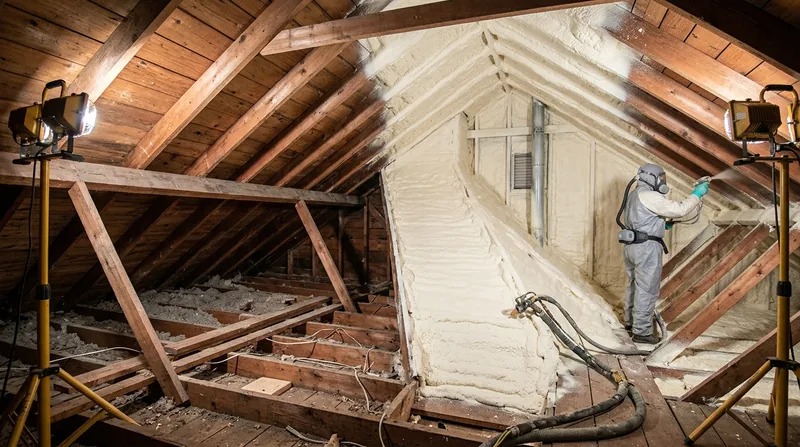




Insulation Replacement & Re-Insulation in Youngstown is the full reset: old material removed, gaps air-sealed, new foam installed to code. In the Mahoning Valley, where 1900s Colonials sit above stone basements and 1950s capes crowd the suburbs with knee-wall bedrooms that freeze in January, insulation fails in predictable ways. Fiberglass flattens under its own weight after twenty years. Ice dam leaks soak attic fill and turn it to pulp. Rodent activity leaves insulation fouled and its thermal value gone. When the old layer no longer performs, replacement is not a cosmetic upgrade, it is the foundation of year-round comfort and control over heating and cooling costs. We remove the failed material, seal the gaps that let conditioned air escape, and install new spray foam to the R-value your home needs under current code.
Why Insulation Replacement & Re-Insulation Matters in Youngstown's Older Housing Stock
Youngstown's neighborhoods, Crandall Park, Wick Park, Brier Hill, and the mill towns of Struthers, Campbell, and Girard, are built on a foundation of early twentieth-century construction. Most homes were insulated, if at all, with materials that have now reached or passed their service life. Fiberglass batts and blown-in cellulose compress over time, especially in attics where summer heat and winter cold cycles work the material constantly. Vermiculite, common in homes built before the 1980s, cannot be safely disturbed and must be left in place. When insulation fails, energy leaks through the attic, through rim joists above basements, and through walls where the original fill has settled or shifted.
- Flattened or compressed fiberglass loses R-value and allows warm air to rise straight out of the home in winter.
- Ice dam leaks in heavy snow years soak insulation and leave it permanently compromised, even after the water dries.
- Rodent activity and contamination make old insulation unsafe and ineffective, requiring full removal and replacement.
- Settled blown-in cellulose or fiberglass creates gaps at walls and around penetrations where air escapes unchecked.
- Code has advanced; homes insulated to R-19 or R-30 standards from 1990 now need R-38 to R-60 to meet current efficiency targets.
Replacement is the answer when repair or top-up no longer makes sense. Our process includes mechanical removal of the old material, thorough air sealing of gaps and penetrations, and installation of new spray foam to the R-value and thickness required by code at your address. For details on what the code requires in your zone, contact your local building department or call us at (330) 406-5409.
Key info: In Youngstown, Boardman, and Austintown, ice dam damage is the single biggest driver of attic insulation failure. Heavy wet snow loads in January and February can force water under shingles and into the attic cavity, soaking fiberglass and cellulose. Once wet, that material never fully recovers its thermal performance and must be removed and replaced.
How We Handle Insulation Replacement & Re-Insulation in Youngstown Homes
The replacement process is methodical and site-specific. We begin with a walkthrough to assess what is in place, its condition, and what gaps or air leaks exist. We take measurements and confirm the R-value and thickness needed to meet code at your address. We then provide a written estimate with those specs clearly stated. Once you approve, we schedule the work, set up containment and ventilation, remove the old material, seal penetrations and rim areas, and install new foam to specification. The whole job, from setup to final cleanup, typically takes one to three days depending on attic size and complexity.
- We inspect the attic or wall cavity to identify wet spots, rodent damage, or structural issues that must be addressed before foam is applied.
- We remove old insulation, batts, blown-in fill, or failed foam completely and haul it away; nothing is left behind.
- We air-seal rim joists, band joists, rim board gaps, and penetrations around ductwork and electrical before foam application.
- We spray foam to the R-value and thickness specified in the estimate, using closed cell or open cell depending on the application and your needs.
- We provide mechanical ventilation during cure and a re-entry window of twenty-four to forty-eight hours before the space is occupied.
- We clean the site, remove all debris, and leave the attic or wall cavity ready for drywall, flooring, or other finishing work if needed.
A typical example: a 1960s ranch in Canfield with a flattened attic of original fiberglass and a history of ice dam leaks. We remove the old material, seal the soffit gaps and rim joist, spray 5.5 inches of closed cell foam for R-38 coverage, and allow forty-eight hours cure before the homeowner re-enters. The result is an attic that stays dry, holds heat in winter, and resists condensation year-round. See our attic spray foam insulation page for more on sealed attics.
Real scenario: A 1920s Colonial in Wick Park with a third-floor bedroom above an uninsulated attic. Summer heat made the room unbearable; winter drafts froze it. We removed the old mineral wool, sealed the rim and all ductwork penetrations, and sprayed 6 inches of open cell foam for R-38. The room is now comfortable year-round, and the homeowner has cut attic air leaks by over 90 percent. See our open cell spray foam page for details on this method.
Insulation Replacement & Re-Insulation Methods
| Approach | Description | Best for |
|---|---|---|
| Closed Cell Spray Foam Replacement | Dense, rigid foam applied at 2 to 3 inches per pass to reach R-6 per inch. Seals air gaps completely and resists moisture intrusion. | Attics with ice dam history, crawl spaces with humidity risk, rim joists, and any cavity where air and moisture control are critical. |
| Open Cell Spray Foam Replacement | Lighter, semi-rigid foam applied to full depth in one or two passes. Achieves R-3.5 per inch and allows vapor permeability, useful where drying is needed. | Attics in dry climates, sound-dampening applications, and homes where vapor balance matters and moisture risk is low. |
| Removal Plus Blown-In Replacement | Old material removed completely. New blown-in cellulose or fiberglass installed to target R-value. Lower cost than spray foam but less air sealing. | Attics with sound structural integrity, no air leak issues, and budgets that favor material cost over long-term air sealing performance. |
| Injection Foam in Walls | Closed cell foam injected into wall cavities of pre-1980 homes without demolition. Fills settled or empty cavities from the interior. | Balloon-framed worker homes and two-family houses in Brier Hill, Smoky Hollow, and Struthers with thin walls and no original fill or settled fill. |
Insulation Replacement & Re-Insulation Cost in Youngstown: What to Expect
Pricing for insulation replacement depends on the size of the space, the R-value target, the condition of the substrate, and the removal scope. A typical attic replacement in a Youngstown home starts at around $2,800 for a smaller space or a straightforward removal and foam spray. Larger homes, complex geometries, or attics with structural work required will cost more. The best way to know your actual cost is a site visit and written estimate with R-value and thickness clearly stated. We provide that estimate free and without obligation.
Factors that affect the final price include the square footage of the space, the depth of foam needed to meet code R-values at your address, the complexity of air sealing required, whether old insulation is wet or contaminated (which can affect removal logistics), and access to the space. A ranch in Liberty with a straightforward attic will cost less than a Colonial in Canfield with multiple rim sections and a basement bulkhead to seal. Travel to your address in Youngstown and surrounding areas is included in our pricing; there is no separate mileage charge.
We recommend getting two or three estimates from contractors who are fully insured and who provide written specs with R-value and thickness. Avoid any estimate that omits those details, quotes a price far below market without inspection, or promises immediate re-entry after foam application. See our full pricing page for a detailed breakdown of typical jobs and what moves the cost up or down.
What to Look for When Hiring a Spray Foam Insulation Contractor Near Youngstown
The spray foam insulation market includes both local independents and national franchises, and both legitimate shops and rig-and-run crews that spray in an afternoon and are unreachable when questions arise later. The differentiator is honesty and verifiable performance. A good contractor provides a written estimate with R-value and thickness specified, explains why they recommend closed cell or open cell for your situation, and is transparent about what spray foam does and does not do. They are fully insured and can provide proof of coverage. They explain the cure process, the re-entry window, and what mechanical ventilation will run during application. They do not promise lifetime warranties, do not claim spray foam is non-toxic or 100 percent safe, and do not offer mold remediation or rodent removal as part of the insulation job.
- Ask any contractor for proof of current insurance coverage and verify it covers spray foam application and liability.
- Request a written estimate that includes R-value per inch, total thickness in inches, and square footage or board feet to be sprayed.
- Ask whether they will perform mechanical ventilation during cure and what re-entry timeline they recommend before the space is occupied.
- Verify that the contractor understands local building code requirements for your address; permitting and code vary across Youngstown, Boardman, Austintown, and other cities.
- Ask for references from recent jobs in your city or a neighboring city, and follow up with at least two homeowners to ask about the experience and the result.
- Do not book based on price alone; a bid far below market often signals shortcuts in material, technique, or insurance verification.
If you have questions about whether your home or project requires a permit, contact your local building department first; they will tell you what applies at your address. For spray foam work in Youngstown, call the Youngstown Building Department. For work in Boardman, Austintown, or other surrounding cities, check with that city's building office. Once you know what is required, any qualified contractor can help you navigate the permitting process, but the rule and the decision rest with the building official, not the contractor. To discuss your specific home and get a free, no-obligation estimate, contact us at (330) 406-5409. We respond within 24 hours.
Insulation Replacement & Re-Insulation in Youngstown: Pricing Guide
| Service | Price | Details |
|---|---|---|
| Attic Replacement (500-800 sq ft) | Starting at $2,800 | Removal of old material, air sealing, and closed cell foam to R-38 or R-49 per code. Cost rises with attic size and complexity of rim sealing. |
| Smaller Space or Top-Up (under 500 sq ft) | Starting at $1,400 | Removal and replacement of insulation in a single room, knee-wall area, or garage. Price depends on depth and R-value target for that zone. |
| Wall Cavity or Rim Joist Injection | Starting at $800 | Injection foam into existing wall cavities or rim board gaps without demolition. Cost varies with linear footage and cavity depth to be filled. |
| Multi-Zone or Complex Retrofit | On estimate | Attic plus crawl space plus rim joists, or homes with structural complications, wet substrates, or extensive air sealing. Site visit required for accurate pricing. |
| Travel | Included | No separate mileage or call-out fee for jobs in Youngstown, Boardman, Austintown, Canfield, Poland, and surrounding service areas. |
| Estimate | Free | Written estimate with R-value and thickness specifications. Response within 24 hours at (330) 406-5409. No obligation to book. |
Indicative pricing, the exact cost depends on square footage, finish, and site access. Free personalized estimate within 24h at (330) 406-5409.


