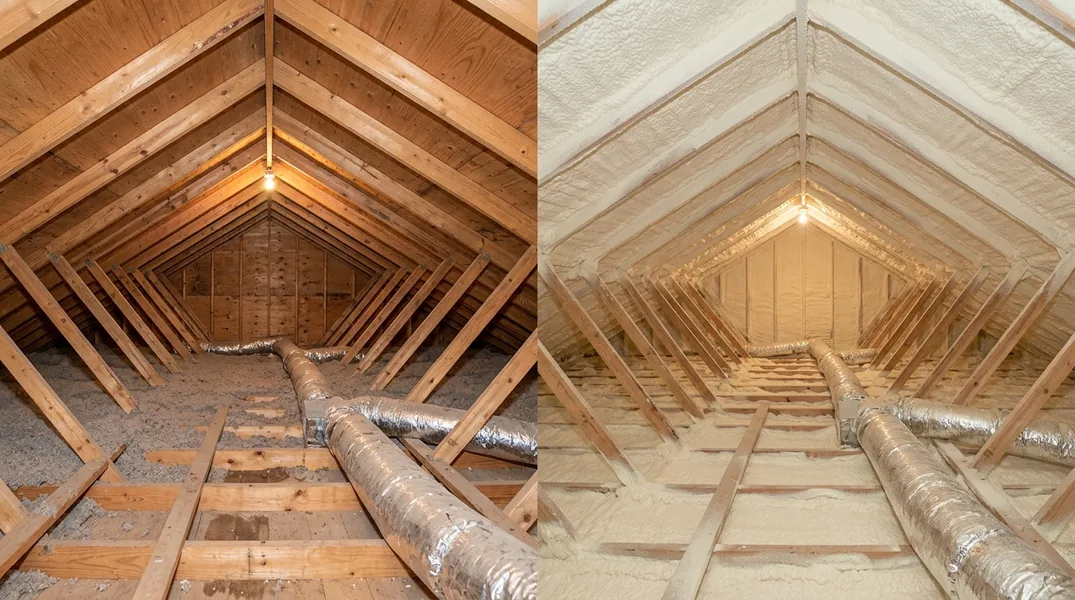
The Insulation Challenge in Youngstown's Historic Homes
Youngstown's architectural heritage tells the story of America's industrial boom. The homes built during the steel era, roughly from the 1890s through the 1950s, represent craftsmanship and character that modern construction often lacks. However, these same homes present a unique problem for today's homeowners: they were built before modern insulation standards existed, and their construction methods create challenges that traditional insulation materials simply cannot address effectively.
If you own one of these classic Youngstown properties, you've likely noticed higher heating and cooling bills, cold spots in winter, and difficulty maintaining consistent temperatures throughout your home. The culprits are balloon framing, thin exterior walls, and stone basements. These structural features made sense when labor was cheap and energy costs were low, but today they represent significant energy inefficiency. Understanding these challenges is the first step toward finding the right solution for your home's insulation needs.
Understanding Balloon Framing and Its Insulation Problems
Balloon framing was the dominant construction method in Youngstown during the steel era, and it differs dramatically from modern platform framing. In balloon frame construction, vertical studs run continuously from the foundation to the roof, with floor joists nailed directly into these studs. This method was faster and used less wood than modern techniques, but it created a critical problem: continuous vertical cavities that run from the basement to the attic.
These open cavities act like chimneys, allowing warm air to rise out of your home in winter and hot air to penetrate downward in summer. Traditional fiberglass batts and blown-in cellulose cannot seal these cavities effectively because they leave gaps around the studs and cannot bridge the open spaces. Even worse, if there's ever a fire, these cavities can allow flames to spread rapidly through the entire wall structure. Wall & Injection Foam Insulation solves this problem by filling every cavity completely, creating an airtight seal that stops convective heat loss and provides both thermal and fire-resistance benefits that older insulation materials cannot match.
Thin Walls and the Limits of Traditional Wall Insulation
Steel-era homes were built with exterior walls that are significantly thinner than modern construction standards. Where today's homes typically feature 2x6 studs with 5.5 inches of cavity space, historic homes often have 2x4 studs with just 3.5 inches of space. Some older properties have even thinner walls. This limited cavity depth creates a real problem: standard fiberglass batts (which are designed for 3.5-inch cavities) compress when installed, losing their R-value, and they still leave air gaps that reduce their effectiveness.
Closed Cell Spray Foam Insulation is the ideal solution for thin wall cavities because it expands to fill the space completely and hardens into a rigid foam that provides superior thermal resistance per inch. A 3.5-inch layer of closed cell foam delivers an R-value of approximately 21, compared to R-13 for fiberglass batts. This means you get nearly 60 percent better insulation performance in the same wall cavity. Additionally, closed cell foam acts as a moisture barrier, which is especially important in older homes where water infiltration can damage the structural integrity of thin walls over time.
Stone Basements and Below-Grade Insulation Solutions
Many historic homes in Youngstown have stone or brick basements that are notoriously difficult to insulate. Stone is porous and prone to moisture problems, and the irregular surface makes it nearly impossible to install traditional batts or rigid foam boards effectively. Homeowners often resort to leaving these basements uninsulated or using ineffective surface treatments that don't address the root problem.
Closed Cell Spray Foam Insulation adheres directly to stone surfaces and creates a continuous thermal barrier that is impervious to moisture. The foam seals air leaks at the rim joist (where the wall meets the foundation), which is a major source of heat loss in older homes. By insulating the basement walls and rim joist with spray foam, you can significantly reduce the energy loss that occurs through below-grade surfaces. This is particularly important because basement walls are in direct contact with earth, which acts as a heat sink in winter, pulling warmth out of your home.
Old Insulation Removal and the Case for Professional Assessment
Before installing new insulation in a historic home, old insulation removal may be necessary. Many homes built before the 1970s contain asbestos-laden insulation, vermiculite (which may contain asbestos), or other hazardous materials. Attempting to remove these materials yourself can expose your family to serious health risks. Professional assessment is essential to identify what's currently in your walls, attic, and basement before any work begins.
This is where working with an experienced local contractor becomes invaluable. A qualified professional can inspect your home, identify hazardous materials, determine the safest removal method, and plan your new insulation strategy accordingly. In many cases, spray foam can be applied directly over existing insulation if it's not hazardous, which reduces removal costs. However, if old insulation removal is required, professionals follow strict safety protocols to protect your family and the environment. Getting a free estimate from Youngstown Spray Foam Insulation allows you to understand exactly what your home needs and what the process will involve.
Why Spray Foam Outperforms Other Solutions for Historic Homes
When you're dealing with the specific challenges of balloon framing, thin walls, and stone basements, spray foam insulation offers advantages that no other material can match. Attic Spray Foam Insulation seals air leaks while providing thermal resistance, addressing both comfort and energy efficiency simultaneously. The foam expands to fill cavities completely, eliminating the gaps that plague traditional insulation. It adheres to any surface, whether it's wood, stone, or metal, making it ideal for the irregular surfaces found in older homes.
Both Closed Cell Spray Foam Insulation and Open Cell Spray Foam Insulation have their place in historic home insulation, depending on your specific needs and budget. Closed cell foam provides superior R-value and moisture resistance, making it the better choice for basements and exterior walls. Open cell foam is lighter, more affordable, and works well in interior applications where moisture isn't a concern. Your contractor can recommend the best approach based on your home's condition and your goals.
Historic homes have character and charm that modern construction can't replicate, but they don't have to be energy hogs. With the right insulation strategy, you can preserve your home's historic integrity while dramatically improving its energy efficiency and comfort. If you're ready to address the insulation challenges in your steel-era home, contact Youngstown Spray Foam Insulation at (330) 406-5409 to discuss your options and schedule a free estimate today.
Looking for a professional spray foam insulation contractor in Youngstown? Youngstown Spray Foam Insulation responds fast for all your spray foam insulation needs.
Get a Free Quote